The March 2026 core and spam updates told Google to stop handing the microphone to chatbot sludge. That was the diagnosis. This is the treatment.
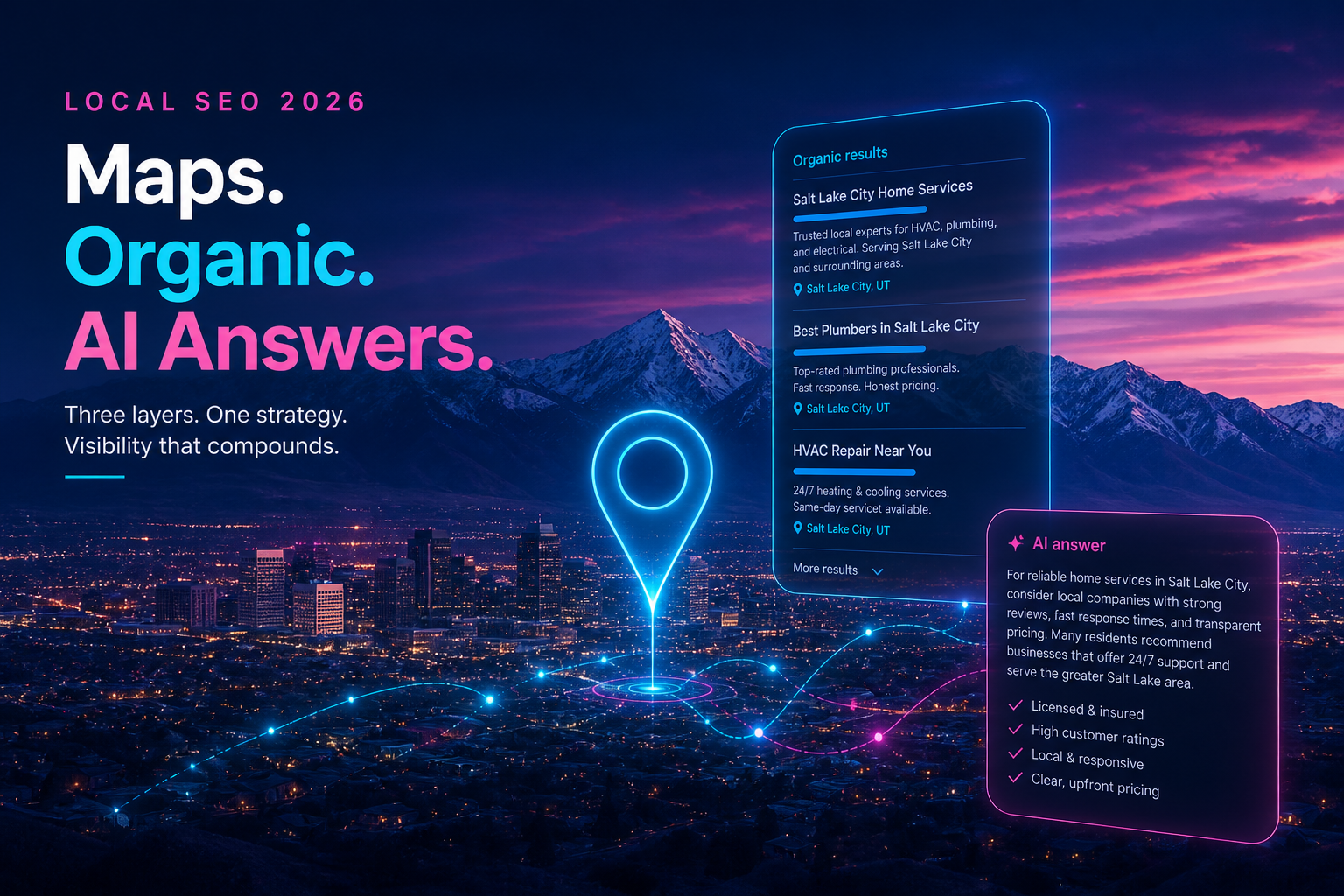
If you cleaned up your Google Business Profile, wrote one honest article, and then waited for the algorithm to send you a fruit basket, you are still playing one game. In 2026, local search is three games at once:
- Maps — the “call me now” layer.
- Organic results — the “I’m comparing you” layer.
- AI answers — the “just tell me who to hire” layer.
Most Salt Lake City businesses are decent at one and invisible at the other two. Ads will not glue those together.
The mistake the March update did not fix for you
Our March 2026 update recap covered what changed and five no-budget moves for the first week. Those still matter. They are also not a strategy.
Google can like your Business Profile and still hide your website. Your website can rank and still never get named in an AI Overview. You can get mentioned by an assistant and have a homepage that cannot take the handoff — no offer, no proof, no next step.
That last one is how SLC owners lose money they already paid to attract. Local SEO in 2026 is not “rank higher.” It is show up on the surface the buyer is using, then convert them on something you own.
Surface 1: Maps is still the cash register
When someone types “emergency plumber near me” from Sugar House at 9 p.m., they are not reading your manifesto. They are looking at the map pack, photos, hours, and the last three reviews.
What “alive” actually looks like in 2026
- Primary category is brutally accurate. Secondary categories are real services, not wishful thinking.
- Hours, service areas, and attributes match how you operate — including accessibility details if they are true. Do not invent them.
- Photos are from this quarter, this shop, this crew. Stock Wasatch sunsets do not prove you exist.
- Reviews get replies in the same week, in a human voice. “Thanks for your feedback!” is wallpaper.
- Posts and Q&A answer the questions people already ask you on the phone.
Your profile also feeds Google’s AI surfaces. There is no secret “AI toggle.” A complete, current listing is how you stay in the candidate set when Gemini summarizes “best [service] in Salt Lake City.” Thin profiles get skipped. Quietly.
Surface 2: Organic is where they decide you are not a risk
Maps gets the call. The website gets the doubt. People still open three tabs: do you work in their part of the valley, have you done this job, and will you ghost them after the invoice?
A single “Utah” service page is lazy. Salt Lake City, Millcreek, Sugar House, West Valley, and Lehi do not share the same searcher or the same proof.
Build pages people can cite
You do not need 40 location pages you cannot maintain. You need one honest page per market you actually serve, plus two or three research-stage pieces that answer the questions buyers already ask:
- What it costs here (ranges, not theater).
- What to ask before they hire anyone.
- What goes wrong when they pick the cheapest option.
Write like you have done the work. Short paragraphs. Real constraints. If you are Deaf-led or ASL-first, say how clients work with you — that is a differentiator, not a slogan.
This is also where SEO and content either compounds or embarrasses you. Thin copy is what the March core update is still chewing through. The rewrite checklist is your service pages are commodity content.
Surface 3: AI answers pick a name, not a keyword
AI Overviews and assistants do not “rank” you the way blue links do. They choose who to mention. The businesses that get named usually have the same stack:
- A complete Google Business Profile.
- On-site answers that look like answers — question, short answer, then context.
- Schema that matches the page (FAQ and service markup, not a junk drawer of every type you found on a blog).
- Proof somewhere Google already trusts: reviews, a local citation, a real case, a chamber or trade mention.
You cannot hack onto that list with synonym soup. You can become easy to quote.
Make one page “cite-worthy” this month
Pick your highest-intent service. Open the page. If the first screen is fluff, rewrite the first 80 words so a stranger could steal the answer without scrolling. Then add:
- The service area you actually cover (miles, neighborhoods, not “Greater Utah”).
- A proof snippet: a result, a constraint, a “we don’t do X.”
- Three FAQs copied from real intake calls, not from a keyword tool’s imagination.
That is Answer Engine Optimization without the cult — and a better page for humans, which is the only test that still matters.
One concrete SLC example (steal the pattern, not the trade)
A Sugar House HVAC shop we audited last spring ranked in Maps for branded and a couple of “near me” terms. Their organic page was a statewide brochure: “Serving all of Utah since…” with a stock photo of a unit that was not theirs.
They were invisible for queries like “furnace repair Sugar House” and never showed up when people asked an assistant who to call during inversion season.
We did not buy ads. We did three things:
- Tightened the Business Profile: primary category, services, photos from actual installs on 2100 South, replies to the six reviews they had been ignoring.
- Split the fake statewide page into a Salt Lake City / Sugar House service page with real neighborhoods, parking notes, and what same-day actually means when I-15 is a parking lot.
- Published one useful piece: how to tell a dirty filter from a dying furnace when the inversion sits on the valley — written from truck notes, not from a language model.
Calls from the profile went up first. Then the service page started catching the comparison traffic. The article became the thing people forwarded. That is the three-surface stack in one zip code.
Lehi and Silicon Slopes need more B2B proof: method, timeline, what you measured. Downtown and 9th & 9th still want speed and a human who answers.
What to measure so you do not lie to yourself
Stop refreshing a rank tracker like it is a slot machine.
Watch:
- Calls, direction requests, and messages from the Business Profile.
- Form submits and booked consults from service pages.
- Whether your brand gets named in AI answers for three queries you care about (check monthly, not hourly).
- Email or SMS list growth from the site. Owned audience. The only list Google cannot re-rank overnight.
The 30-day local stack (no ad account required)
Week 1 — Maps. Categories, photos, reviews, one post, service list that matches the site.
Week 2 — One market page. Salt Lake City or the neighborhood you actually close in. Kill the generic Utah blob if it cannot tell the truth.
Week 3 — One cite-worthy article. A cost, comparison, or “what to ask” piece with headings a human would use.
Week 4 — The handoff. Homepage and service page CTAs that say what happens next. Analytics that show calls and forms, not just sessions. A simple email capture so the next algorithm mood swing does not erase the relationship.
That is Innovate-level hygiene plus Accelerate-level consistency: strategy, content calendar, and someone looking at the numbers every two weeks.
Deaf-owned and ASL-first shops: first-hand experience is already the signal. Put it on the page. The March update punished fake expertise. It did not invent a shortcut.
Do this next
Leeper Digital is a Salt Lake City growth marketing agency. We do not sell ads. We build organic systems — SEO, social, email, and a site that can take a punch — so Maps, search, and AI answers have something real to point at.
If your profile is awake but the rest of the stack is a shrug, start with Accelerate: full organic execution plus bi-weekly strategy so this does not die after week two.
Start growing — tell us whether you need Innovate (foundation) or Accelerate (momentum). Dominate stays reserved for Deaf-led, ASL-first work.