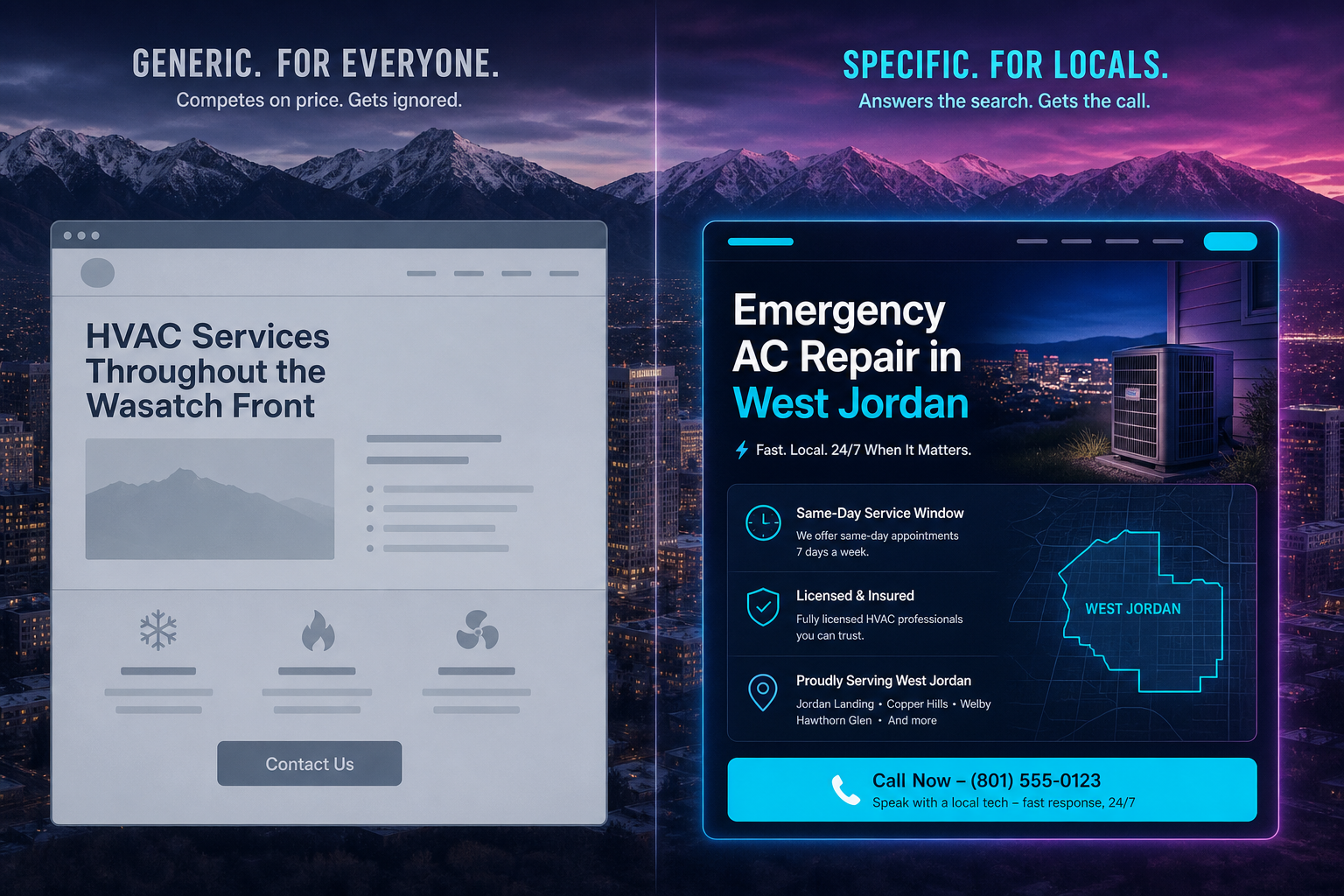
Utah owners love a content calendar. Two blogs a week. A “thought leadership” series. A LinkedIn carousel about “trends.”
Meanwhile the page that should close the job — HVAC repair Salt Lake City, family lawyer South Jordan, dentist Draper — reads like it was written by a committee that has never set foot on I-15.
That page is commodity content. Google already said so. Buyers already bounce. Ads will not save it. Leeper Digital does not sell ads. We sell organic systems. Start with the service page that should already close.
Zero-click did not kill high-intent. It exposed thin pages.
SparkToro, using Similarweb clickstream for January through April 2026, found 68.01% of U.S. Google searches ended with no click anywhere — up from 60.45% in 2024. AI Overviews show on 20%+ of searches and, when present, cut CTR by roughly 60%.
That is the informational fluff tax. SparkToro’s own advice still names the categories that keep winning clicks: branded search, local businesses, and high-intent transactional or tactical queries.
Your service page is supposed to be that last bucket. If it is a recycled “we’re passionate about excellence” brochure with a city name duct-taped into the H1, you are not competing for the click. You are donating it to whoever wrote a real answer.
The Local SEO in 2026 playbook covers Maps vs organic vs AI. The honest SEO timeline covers how long that click takes. This piece is that page.
Google’s word for your page: commodity
In Google’s generative AI optimization guidance (Search Central), the company draws a hard line.
Commodity content is the stuff anyone could churn: “7 Tips for First-Time Homebuyers.” Common knowledge. No unique insight. Easy for a model to invent.
Non-commodity content is experience-backed and specific: “Why We Waived the Inspection & Saved Money: A Look Inside the Sewer Line.” First-hand. Hard to fake. Useful after the visit.
Same guide: unique, compelling, useful content will influence long-term presence in generative AI features more than any other suggestion in the document. SEO still matters because AI Overviews and AI Mode are grounded in core Search ranking. There is no magic `llms.txt` cheat code. There is no special AEO markup Google asks you to invent.
The helpful-content guidance is blunter still. Ask whether the page provides original information, a complete description of the topic, and value beyond the obvious. Ask who created it, how it was made, and why — if the why is “rank for a keyword,” you are writing for the engine, not the buyer.
Your service page fails that test when:
- It could swap “Salt Lake City” for “Boise” and still make sense.
- It lists every service you offer on one URL instead of owning one job.
- It has no process, no proof, no neighborhood truth, no decision criteria.
- The CTA is “Contact us” with a form that asks for a novel.
That is search-engine-first cosplay. Google’s raters and systems are trained to smell it.
If the whole site is still a brochure, start with how an SLC website starts making money without ads. Then come back and fix the service page.
What “non-commodity” looks like on a Utah money page
You do not need 2,000 words of blog theater. You need a page a serious buyer would bookmark or forward to a spouse.
1. One job, one market, one URL
Pick the service you actually close. Pick the market you drive to. “Emergency AC repair in West Jordan” beats “HVAC services throughout the Wasatch Front.” Distance is a local ranking factor Google names in plain English: relevance, distance, prominence. Pretending you cover every zip from Ogden to Provo dilutes relevance and wastes the click.
If you serve South Jordan, Draper, Sandy, Herriman, or Sugar House as primary jobs, say so with hours, response windows, and what “same day” actually means in traffic.
2. Answer the buying questions in the first screen
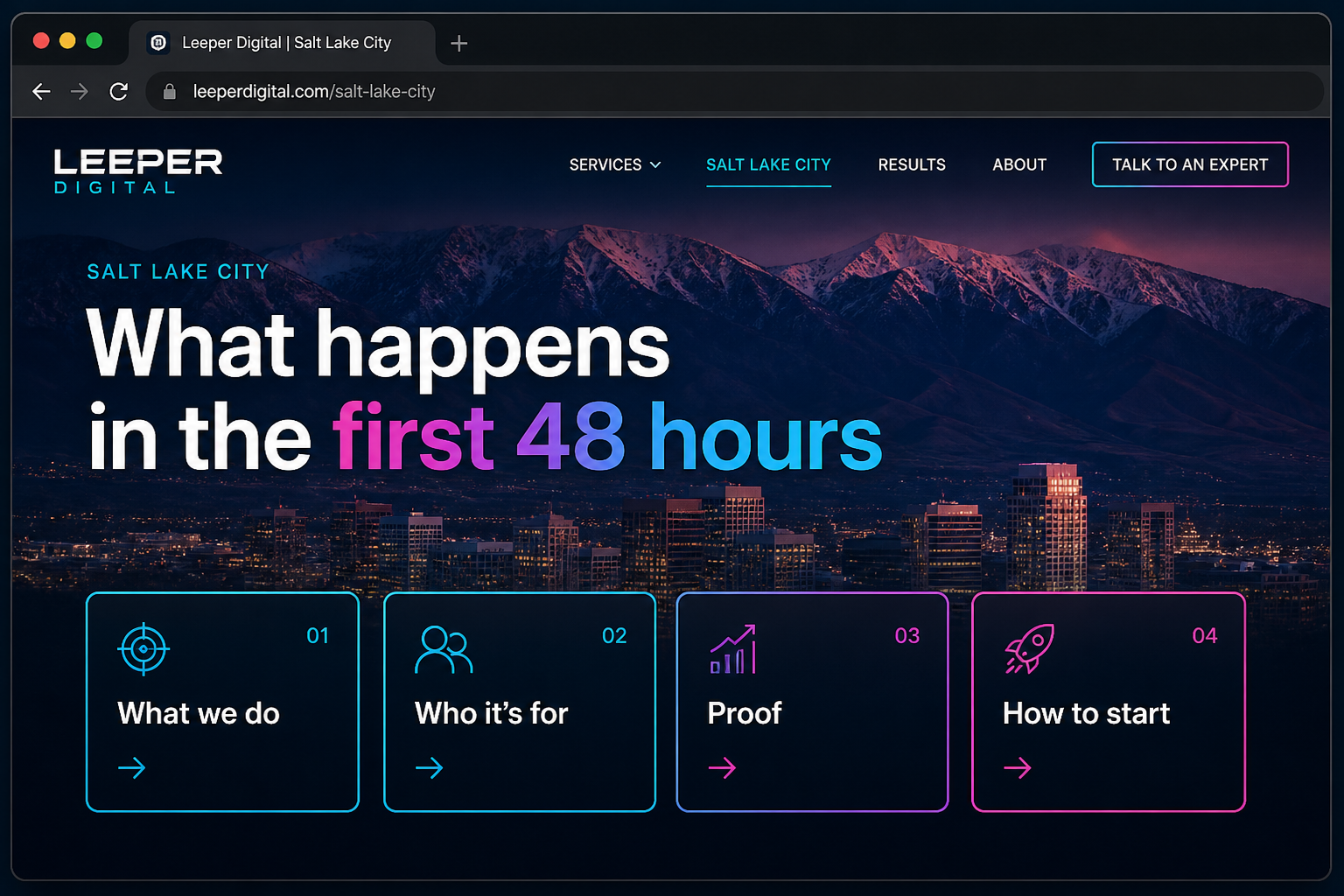
Before the stock hero photo finishes loading, answer:
- What exactly do you do on this job?
- Who is it for (and who should call someone else)?
- What happens in the first 24–48 hours?
- What proof do you have (licenses, years on this work, review themes, before/after, case sketch)?
- How do they start without a scavenger hunt?
Google’s generative AI guide asks for clear structure: paragraphs, sections, headings people can navigate. Put the answer up top. Expand below. That helps humans and the systems that quote you.
3. Put your proprietary process on the page
Commodity pages hide the work. Non-commodity pages show it.
Name the steps you actually run. What you inspect. What you refuse. What Utah winters or summer heat change about the job. What a Deaf-led or ASL-first client should expect on Zoom versus on-site. That is experience Google’s E-E-A-T framing cares about: trust first, with experience and expertise feeding it.
If a competitor can paste your copy into ChatGPT and get the same page back, you do not have a process. You have filler.
4. Align the site with the Business Profile (without keyword stunts)
Google’s Business Profile guidelines are clear: represent the business accurately, choose the fewest categories that describe the core business, and do not stuff names with services, cities, or taglines. Local ranking tips from Google: complete info, correct hours, real categories, reviews you actually reply to, photos that show the work.
Your service page and your profile should tell the same story. Same NAP. Same services you actually sell. Same service area you can staff. Maps relevance is “how well a Business Profile matches what someone is searching for.” A money page that contradicts the profile teaches Google and the buyer that somebody is lying.
Do not invent categories as keywords. Put job-level detail in services, photos, reviews, and the page itself.
5. Make the page experience survive the click you earn
Core Web Vitals are part of ranking systems. Google still says relevance can beat a mediocre experience, but when many pages are “good enough,” experience is how you win the tie — and how you keep the lead once they land.
For Salt Lake City operators that usually means: mobile-first layout, HTTPS, no full-screen popup the second they arrive, main content obvious, form short enough that a person on a job site can finish it with one thumb.
Blog posts after money pages, not instead of them
Blogs still matter for topical depth, AI citations, and the long game. Google’s own guide says internal links and related coverage help systems understand you have depth, not one orphan URL.
Order of operations for most SLC shops:
- Fix the service page that should already be earning the high-intent query.
- Align GBP categories, services, photos, and review replies with that page.
- Then publish supporting articles that answer adjacent questions with non-commodity proof — not ten commodity listicles hoping one ranks.
If your calendar is full and your money pages are empty, you are doing SEO cosplay. We see it every week from South Jordan to Lehi.
If you are not ranking at all, read 5 reasons an SLC business is not ranking on Google and what the March 2026 update actually changed. Then fix the money page anyway.
What we do (no ads, no fake #1)
Leeper Digital is organic-first growth marketing out of the Salt Lake area. Innovate is foundation and roadmap. Accelerate is the popular ongoing lane: strategy, content, SEO, conversion. Dominate is ASL-first and reserved for Deaf-led owners.
We will not quote prices here. We will not promise page-one in thirty days. We will tell you if the page is commodity and what to rewrite first.
That work lives on the services money page and the city pages we actually staff: South Jordan, Draper, Sandy, Herriman.
Next step
If your service page could belong to any competitor in Utah, send it over. Name, business, city or market, goal, timeline, and whether you prefer email, Zoom, or ASL.
Email [email protected], text (385) 380-3383, or use the contact page.